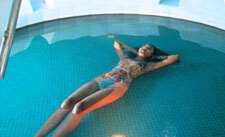
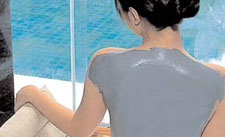
From the icy Polar Regions to the balmy tropics of the earth, water in its many guises is a source of life. Like air, water is essential. Without it we would wither and die. In its variable forms it has the power to heal, calm, invigorate and destroy. Water’s transformative qualities make it a universal symbol of fertility, birth, regeneration and purification. The word spa is rooted in the Latin sanus per aqua meaning “health through water” and as ice, liquid or steam, H20 is central to the idea of spa.
The northern Thai folklore manuscript Pathamamulamuli contains a description of the creation of the world. Translated by Anatole-Roger Peltier it beautifully illustrates how everything that is springs from water. “When the world was not yet in existence, there were only the cold and the hot. By coming together and by feeding each other, these two states of matter gave rise to a wind that blew very strongly and called into existence the earth and water. The moisture released by rocks produced mosses and seaweeds which, in turn, gave rise to grasses, plants and trees. Insects such as fleas and beetles were born from the elements earth, water, fire, then beings endowed with bones and blood. From the element earth a woman called Nang Itthang Gaiya Sangkasi was born. The scent of flowers was her only food. Mixing her sweat with clay, she molded animals so that they ate the plants that grew in plenty.”
The Thai people have an enduring relationship with water and both are inextricably entwined. Water lies at the heart of the Songkran and Loy Krathong festivals celebrated annually in April and November respectively. Early communities congregated on rivers or canals, or by the sea, while some lived in floating houses. Natural springs, streams and rivers are regarded the world over as special places where magical supernatural beings live. The mythical serpent or naga, which is commonly seen in traditional Thai architecture, symbolises water. It is said to live underground, or in water and links water with the earth. One of its roles was to protect the Buddha whilst he meditated. The sacred lotus, a water plant, is depicted in art and is commonly offered to monks in temples throughout Thailand. It rises up from the water representing the enlightened Buddha, free of earthly cares and illuminated with the light of spirit.
The sound of water is as restorative as its form. Rhythmic ocean waves can transport us to a meditative state, whilst the crash of monsoon rains remind us of the power of nature. The world over, rain is described in numerous and often romantic ways. On a more mundane plane, water takes up more than 60 percent of our body weight. Evolutionists tell us that we originated in the ancient oceans where the first primitive life forms began and thus our affinity with the sea. We cry salty sea tears. Even the ratio of electrolytes in our body is equivalent to that of seawater.
An array of water treatments, all broadly classified under hydrotherapy, includes baths and showers, hot and cold compresses, body wraps and salt scrubs. Hydrotherapy is essential for improving health conditions, alleviating pain, beautifying the body and managing stress. When applied therapeutically it can stimulate the immune system, boost blood circulation, eliminate toxins, soothe and invigorate. It is one of the most versatile media for health maintenance.
Painful conditions such as arthritis or muscular pain respond well to hydrotherapy because its main focus is to help the body eliminate toxins. Conditions thought to be caused by toxic residue, and the discomfort that often accompanies them, can be greatly alleviated by immersion in heated water. In fact many health problems can be diminished with a regular application of directed water because of its ability to increase blood circulation to affected areas of the body. No spa visit is complete without a water treatment and by having a hydrotherapy treatment at a favourite spa, or dipping in a river or floating on gentle ocean waves, we are “taking the waters” and experiencing spa’s original essence.
 THAI WATER THERAPIES THAI WATER THERAPIES
Water therapies found in Thai spas include traditional as well as Western methods. The unmistakable bouquet of the traditional Thai herbal steam may be found all over the country. Commonly used herbs such as lemongrass, galangal or ginger root, kaffir lime leaf, basil and camphor were traditionally boiled in a pot which was placed in a makeshift tent. The fresh scent of the herbs in the resulting steam was inhaled, improving blood circulation and cleansing the skin. Today Thai herbal steam rooms range from traditional-style tent arrangements to sophisticated steam rooms. Thai herbal baths use similar herbs to those used for steam, bruised in a mortar, placed in a cloth bag and soaked in the bath. The effect is calming and uplifting, providing welcome relief for overworked muscles or irritated skin.
Thailand is known for its therapeutic hot compresses containing numerous herbs. Fresh or dried, the herbs are tightly bound in fabric, steamed until piping hot and firmly rolled, pressed or pounded over the entire body. Compresses are traditionally applied after Thai Massage to prevent bruising, reduce muscle stress and cure skin conditions. The contents are prescribed according to the condition being treated, with some of the most commonly used herbs being zedoary (khamin oi), turmeric (khamin chan), lemongrass (takhrai), kaffir lime (makrut), camphor tree (naat), tamarind (makham) and plai (scientific name: zingiber cassumar).
SHOWERS AND BATHS
The simplicity of running a bath after a hard day has a near miraculous effect. People who are tense, overworked and stressed do well by soaking in a hot bath. Heat has a calming effect, slowing the activities of the internal organs. If tired and in need of rejuvenation, a hot bath followed by a cold shower invigorates and stimulates body and mind.
The Vichy shower is a wet treatment where the client lies on a table whilst alternating hot and cold water is sprayed from above from a minimum of seven showerheads. Asian-designed versions are often made of beautiful, local materials such as brass, bamboo or wood that work well with the natural spa ambience. Swiss shower therapy sprays water overhead and at the sides of the body. The jets are alternately powerful and gentle and the temperature is also varied. Scotch hose treatments alternate hot and cold water at high pressure whilst the client is standing.
This is a specific hydro massage treatment and is highly stimulating for the lymphatic and circulatory systems. Jacuzzi or whirlpool baths are commonly found all over the world. Warm water is sprayed from jets placed at the side and sometimes from the bottom of a tub. This is an effective and accessible remedy for stress and tired muscles.
BODY WRAPS
Wet spa treatments such as classic body wraps utilise various seaweeds and sea muds containing trace elements, vitamins and minerals. Mud from moors around the world is a rich source of ancient herbs and flowers that are extremely beneficial to health. Both seaweed and mud boost blood circulation, tone and re-mineralise the skin as well as eliminate toxins.
BODY SCRUBS Rice is plentiful and a number of varieties are native to Asia. It is no coincidence that this water-loving grain is widely used as an exfoliate in body scrubs. Another popular choice is sea salt. Both make skin smooth and soft and salt has the extra benefit of being packed with healthy minerals.
UNDERWATER MASSAGE
A feeling of weightlessness adds a dreamy dimension to this massage technique, inducing a deep level of relaxation and release from tension. While floating on an effervescent stream of water, underwater jets continuously massage specific areas such as neck, shoulders, hips, thighs and feet. Meanwhile the therapist uses a high pressure hose to massage specific problem areas.
WATSU A relative newcomer to the scene, Watsu combines some Shiatsu techniques such as pressures and stretching with a sequence of fluid, dance-like movements while the client is fully supported and guided by the practitioner. Like most Eastern-orientated bodywork, Watsu releases blockages along the body’s energy meridians, rebalances energies and deeply relaxes.
|








 Aqua Culture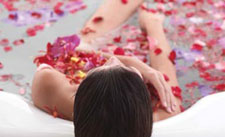
 Beginning of Thailand's Spa